God’s 2nd Commandment means NO crosses in Churches
and
NO crosses on Podiums
NO crosses around your neck
No cross pictures in your Bible.
Read your Bible and ”BELIEVE” what God’s Bible STATES:
Exodus 20:4
And be HOT for the truth not lukewarm, or God will spew you out Revelations 3:16:
16 So then because thou art lukewarm, and neither cold nor hot, I will spue thee out of my mouth.
English Standard Version (ESV)
16 So, because you are lukewarm, and neither hot nor cold, I will spit you out of my mouth.
16 But since you are like lukewarm water, neither hot nor cold, I will spit you out of my mouth!
New
International Version
“You shall not
make for yourself an image in the form of anything in heaven above or on the
earth beneath or in the waters below.
New Living Translation
“You must not
make for
yourself an idol of any kind or an image of anything in the heavens or on the earth or in
the sea.
English Standard Version
“You shall not
make for
yourself a carved image, or any likeness of anything that is in heaven above, or that is in
the earth beneath, or that is in the water under the earth.
King James Bible
Thou shalt not
make unto
thee any graven image, or any likeness of any thing that is in
heaven above, or that is in the earth beneath, or that is in
the water under the earth:
New King James Version
“You shall not
make for
yourself a carved image—any likeness of anything that is in
heaven above, or that is in the earth beneath, or that is in
the water under the earth;
BECAUSE: We walk by Faith
and not by sight.
2 Corinthians 5:7
New
International Version
For we live by faith, not by sight.
New
Living Translation
For we live by believing and not by seeing.
English
Standard Version
for we walk by faith, not by sight.
Berean
Standard Bible
For we walk by faith, not by sight.
Berean
Literal Bible
For we walk by faith, not by sight.
King
James Bible
(For we walk by faith, not by sight)
New
King James Version
For we walk by faith, not by sight.
The so-called "Staurogram" and the monogram of Christ "XP" played a much more important role.
The custom of making the cross with fingers dates back to the 3rd century. However, the veneration of the cross as a symbol, still common today, is only documented from the 4th century, the reign of Emperor Constantine the Great. The cross, still in use today, is also called 'Crux immissa'.
The cross was not an unfamiliar symbol to pagans either. Crosses and cross-shaped symbols were an integral part of the pagan faith. In this context, the 'wheel of the black sun' is still known today.
Isolated finds, such as an Italian ivory box from around 420, show that the biblical crucifixion scene only gradually began to be depicted.
The 1st Century Church did NOT NOT NOT have crosses, as
a cross in the 1st Century was the same thing as a GUN is today.
Subject: Ankh 3000 YEAR OLD "PAGAN" CROSS
Christ died on a CROSS/STAKE, not an Ankh.
Christ died on a CROSS/STAKE, not an Ankh. 
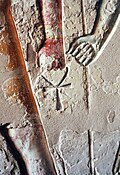 Tomb KV2, found in the Valley of the Kings, is the tomb of Ramesses
IV, CENTURIES
“BEFORE” CHRIST arrived, and is located low in the main valley, between KV7 and KV1.
Tomb KV2, found in the Valley of the Kings, is the tomb of Ramesses
IV, CENTURIES
“BEFORE” CHRIST arrived, and is located low in the main valley, between KV7 and KV1.
This HAS ancient Egyptian PAGAN god roots:
The symbol was originally associated with many gods and goddesses, including
Isis,
Osiris, and
Ra.
Ankh 3000 YEAR OLD "PAGAN" CROSS
It was only until the Christianization of Egypt that the sign was adopted by Egyptian (false) Christians.
The entire Latin alphabet was once pagan symbols. The ankh is the same. It's an Egyptian hieroglyph that represents life. The Egyptians used pictures like these to convey meaning, very similar to how letters in an alphabet represent sounds. The letter "O" is said to have once represented the "divine feminine.
Origin:
The Ankh first appeared in Egyptian art around 3000 BCE during the early dynastic period. It was commonly used in ancient Egyptian religion and funerary practices, and it became one of the most recognizable symbols of Egyptian culture. The symbol was frequently seen in the hands of gods and pharaohs, as a representation of divine power and eternal life.
Meaning:
Life: The Ankh symbolized both physical and eternal life. It was associated with the gods' power to grant life to the living and the dead.
Immortality and Resurrection: It also represented the concept of immortality, particularly in relation to the afterlife. Egyptians believed that the Ankh could offer protection in the journey after death, ensuring the deceased's resurrection and eternal life.
Fertility and Health: Some interpretations link the Ankh with fertility and well-being, as it is often seen in the hands of gods who control these aspects, such as Isis or Hathor.
The Ankh's enduring popularity can be seen across cultures, where it was often adopted by various groups and even became a symbol in modern spiritual and metaphysical movements.
BOTTOM LINE:
It is a SIN to have a cross or an image of a cross period.
Should You Wear a Cross? NO. Because the cross did “NOT” originate
with Christianity,
and has ALWAYS been a symbol for the PAGAN god Tammuz!
- The cross originated with the ancient Babylonians of Chaldea.
- From Babylon, the use of the cross spread to ancient China, India, Mexico, parts of Africa, and many other regions worldwide, long before the Christian era.
- The cross was a widely recognized pagan religious symbol centuries “before” the birth of Christ.
- The pre-Christian cross (particularly the “tau or T-shape) was used in pagan worship as a symbol of Tammuz, the Babylonian false messiah/sun god (the mysterious “T” seen in the Old Testament, Ezekiel 8:14, is explained by ancient sources as this same cross symbol).
- In order to increase the prestige and membership of the apostate ecclesiastical church, large numbers of pagans with crosses were received into the professing Christian churches.
- These pagans were permitted to largely retain their pagan signs, practices, and symbols—including the cross—while being labeled “Christian.”
- As a result, the cross was gradually adopted and promoted as a “Christian,” despite its thoroughly pagan origins.
Wearing or displaying the cross as a Christian symbol is unacceptable because of its direct pagan roots and its incorporation into Christianity through compromise with paganism.
The cross originated among the ancient Babylonians of Chaldea. From there, it spread to ancient China, India, Mexico, parts of Africa and other places.
Warning:
Do NOT be fooled into observing PAGANISM
by sinsters using pagan crosses today.
Part 2 of NO crosses
|
God’s Second Commandment |
“You shall not make for yourself a carved image, or any likeness of anything that is in heaven above, or that is in the earth beneath, or that is in the water under the earth; you shall not bow down to them nor serve them. For I, the Lord your God, am a jealous God, visiting the iniquity of the fathers on the children to the third and fourth generations of those who hate Me, but showing mercy to thousands, to those who love Me and keep My Commandments. Exodus 20:2 |
Iconoclasm
in early Christianity
Historically accurate overview of iconoclasm in early Christianity (from the 1st to the 8th century).
1. 1st–3rd centuries –total absence of religious images
- The earliest Christians produced no crucifixes, no icons of Christ, Mary, or saints, and no statues in places of worship.
- Surviving Christian art (catacombs, sarcophagi) is overwhelmingly symbolic: fish (ichthys), anchor, dove, Good Shepherd, praying figure (orant), chi-rho ☧, staurogram ⳨.
- Direct portrayals of the crucified Christ are virtually non-existent before the late 4th century.
- Many scholars believe this was deliberate avoidance because:
- The cross was still a shameful instrument of execution (Gal 3:13; Heb 12:2).
- Strong Jewish-rooted aversion to anything that could be taken as an idol (Ex 20:4; Deut 5:8; Acts 17:29).
- Early Christian writers (Minucius Felix, Origen, Tertullian, Clement of Alexandria) repeatedly condemn the making of religious images.
2. 4th century – Gradual appearance of the cross and images
- After Constantine (313 Edict of Milan), the cross suddenly becomes public and triumphant (Labarum, visions, etc.).
- First known depictions of the crucifixion appear only around 420–430 AD (Santa Sabina door in Rome, British Museum ivory).
- By the late 4th–5th centuries, images of Christ, apostles, and martyrs begin to appear in churches, but they are still relatively rare and are justified as “teaching tools for the illiterate” (Gregory the Great later).
3. 6th–7th centuries – Rapid growth of icon veneration
- Images (icons) multiply dramatically in the East.
- People begin to bow before icons, kiss them, light candles to them, and attribute miracles to them.
- Some Christians start to worry that this is crossing the line into idolatry.
4. 8th century – The great Byzantine Iconoclastic Controversy (726–843 AD)
This is the most famous and intense period of Christian iconoclasm.
|
Phase |
Years |
Emperor(s) |
Policy |
Key points |
|
First Iconoclasm |
726–787 |
Leo III, Constantine V |
Images banned, icons destroyed, icon-venerators persecuted |
Emperors argued images violate the 2nd Commandment and that icon-venerators were idolaters. |
|
Temporary restoration |
787–815 |
Irene, Nicephorus I |
Icons allowed again (Second Council of Nicaea 787 declares veneration of icons legitimate) |
Distinguished between worship (latreia – only to God) and veneration (proskynesis – to icons). |
|
Second Iconoclasm |
815–843 |
Leo V, Michael II, Theophilus |
Images banned again |
Renewed destruction of icons. |
|
Final restoration |
843–present |
Empress Theodora |
“Triumph of Orthodoxy” – icons permanently restored in the Eastern Church |
Still celebrated every year on the first Sunday of Lent in Orthodox churches. |
5. Iconoclasm outside Byzantium
- Armenian Church – has always been strongly iconoclastic; to this day most Armenian churches have no statues and very few painted icons.
- Paulicians and Bogomils (7th–10th centuries) – radical dualist sects that rejected all images, the cross, and relics.
- Carolingian West (8th–9th centuries) – moderate iconoclasm: the Libri Carolini (c. 790) and the Council of Frankfurt (794) rejected the extreme Byzantine icon-veneration but allowed instructional images.
- Copts and Ethiopian Church – kept images but never developed the intense veneration seen in Byzantium.
6. Summary of the main arguments used by early Christian iconoclasts
- Direct appeal to Exodus 20:4–5 and Deuteronomy 5:8.
- Jesus was crucified on a stake/upright pole (stauros/xylon), not the later T/t-shaped cross, so the traditional crucifix is historically inaccurate anyway.
- No evidence that the apostles or the earliest churches used images or crosses.
- Many pre-Christian cultures already venerated cross-like symbols (ankh, tau, swastika, etc.), so adopting the cross looked like paganism.
- Fear that bowing, kissing, and parading icons is functionally indistinguishable from pagan idolatry.
Bottom line:
Strict iconoclasm (rejection of all religious images and crosses) was the norm in Christianity for the first 300–350 years.
The widespread use and veneration of the cross and icons only became common “after” Constantine and exploded in the 6th–7th centuries. That dramatic shift provoked the biggest internal fight over images in Christian history—the 8th–9th-century iconoclastic controversy—showing that a very large part of the church once believed that visible crosses and images in worship are incompatible with the Second Commandment.
So historically and Biblically, the early iconoclasts have a much stronger case than most modern Christians realize.